Additive Manufacturing 101: A Beginner’s Guide to 3D Printing Technologies

Additive Manufacturing (AM), commonly known as 3D printing, is revolutionizing how products are designed, prototyped, and manufactured. At Paradigm Manufacturing, we leverage a suite of advanced AM technologies to help innovators, engineers, and businesses bring their ideas to life—faster, smarter, and more sustainably. Whether you’re new to 3D printing or looking to expand your manufacturing toolkit, this guide will introduce you to the core AM technologies, their strengths and limitations, and the best use cases for each.
What is Additive Manufacturing?
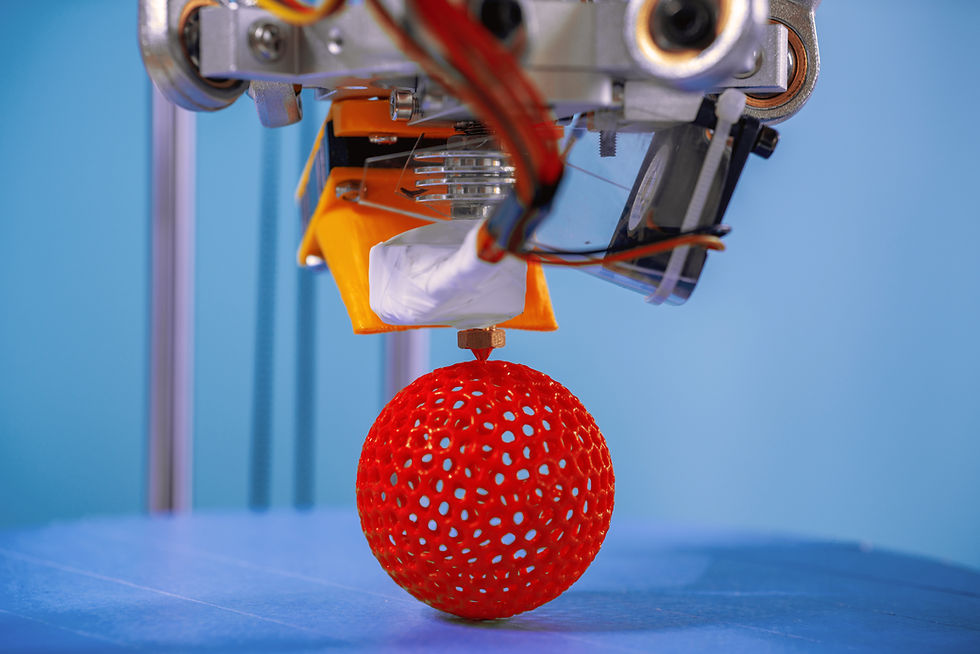
Additive Manufacturing is a process of creating three-dimensional objects by building them layer by layer from digital models. Unlike traditional subtractive manufacturing (which removes material from a solid block), AM adds material only where needed, enabling complex geometries, rapid iteration, and on-demand production.
Key 3D Printing Technologies
1. Fused Deposition Modeling (FDM)
How it Works:
FDM printers extrude melted thermoplastic filament through a heated nozzle, depositing material layer by layer to build up the part. The process is guided by a digital CAD model, and support structures are printed as needed for overhangs or complex shapes.
Materials:
PLA, ABS, PETG, Nylon, Polycarbonate, TPU (flexible), high-performance polymers (PEEK, PEI), and specialty filaments (carbon fiber-reinforced, conductive, dissolvable supports).
Pros:
Cost-effective: Low material and equipment costs make FDM ideal for prototyping and low-volume production.
Material versatility: Wide range of thermoplastics, including engineering-grade and specialty materials.
Ease of use: Simple operation, accessible for beginners and professionals.
Rapid iteration: Fast design changes and prototyping cycles.
Low waste: Only the required material is extruded.
Cons:
Surface finish: Visible layer lines; parts may require post-processing for smoothness.
Resolution: Lower detail and dimensional accuracy compared to other AM methods.
Mechanical properties: Parts can be weaker between layers (anisotropy).
Warping: Susceptible to warping, especially with large or flat parts and certain materials.
Ideal Use Cases:
Rapid prototyping
Functional prototypes and concept models
Jigs, fixtures, and manufacturing aids
Low-volume end-use parts
Educational models and custom medical devices
2. Selective Laser Sintering (SLS)
How it Works:
SLS uses a high-powered laser to selectively fuse powdered thermoplastic (usually nylon) layer by layer. The unsintered powder supports the part during printing, eliminating the need for dedicated support structures.
Materials:
Nylon (PA 12, PA 11), glass-filled or carbon-filled nylons, polypropylene, TPU (flexible), and some specialty polymers.
Pros:
No support structures needed: The powder bed supports complex geometries and internal features.
Strong, functional parts: SLS parts have excellent mechanical properties and are suitable for end-use applications.
High productivity: Multiple parts can be printed simultaneously in a single build.
Design freedom: Enables intricate, functional designs not possible with traditional manufacturing.
Cons:
Surface finish: Parts have a rough, porous surface and may require post-processing.
Material selection: Fewer options compared to FDM or SLA.
Shrinkage/warping: Parts can shrink during cooling, affecting accuracy.
Powder handling: Not all unused powder can be recycled; fine powders require careful handling.
Ideal Use Cases:
Functional prototypes and low-volume production
Complex assemblies with internal channels or moving parts
Jigs, fixtures, and tooling
Medical devices (orthotics, prosthetics)
Automotive and aerospace components
3. Stereolithography (SLA)
How it Works:
SLA uses a UV laser to cure liquid photopolymer resin in a vat, building parts layer by layer with exceptional precision. After printing, parts are cleaned and post-cured to achieve optimal properties.
Materials:
Photopolymer resins: standard, tough/engineering, flexible, high-temperature, biocompatible, and specialty resins.
Pros:
High precision and detail: SLA can achieve extremely fine features and smooth surface finishes.
Versatility: Wide range of resins for different mechanical, thermal, and biocompatible properties.
Rapid prototyping: Fast turnaround for design iteration.
Minimal waste: Only the required resin is used.
Cons:
Material cost: Resins are more expensive than FDM filaments.
Brittleness: SLA parts are generally more brittle and less durable than thermoplastic parts.
Build size: Desktop SLA printers have limited build volumes.
Post-processing: Requires cleaning and UV post-curing; resins can be messy and require careful handling.
UV sensitivity: Parts can degrade with prolonged UV exposure.
Ideal Use Cases:
High-fidelity prototypes and concept models
Dental and medical models, surgical guides
Jewelry and intricate casting patterns
Consumer product prototypes
Master patterns for molding and casting
4. HP Multi Jet Fusion (MJF)
How it Works:
MJF is a powder bed fusion technology similar to SLS but uses inkjet arrays to selectively deposit fusing and detailing agents onto a powder bed, which are then fused by infrared lamps.
Materials:
Primarily nylon (PA 12), with growing options for composites and specialty polymers.
Pros:
Fast, scalable production: High throughput and consistent part quality.
Excellent mechanical properties: Comparable to SLS, with good isotropy.
Fine detail and smooth finish: Better surface quality than SLS.
Cost-effective for batch production: Ideal for both prototyping and end-use parts.
Cons:
Material selection: Currently limited, though expanding.
Equipment cost: Industrial-grade systems require significant investment.
Post-processing: Parts require cleaning and optional finishing.
Ideal Use Cases:
Functional prototypes and end-use parts
Batch production of custom components
Automotive, medical, and consumer goods
Parts requiring fine detail and consistent mechanical properties
5. Other Notable AM Technologies
Direct Metal Laser Sintering (DMLS)
Principle: Laser fuses metal powder layer by layer.
Pros: Strong, complex metal parts; ideal for aerospace, medical, and automotive.
Cons: High cost, slow, requires post-processing.
Use Cases: Turbine blades, medical implants, custom tooling.
Binder Jetting
Principle: Liquid binder glues powder layers (metal, sand, ceramic).
Pros: Fast, cost-effective, no supports, can print in color.
Cons: Parts are weak before post-processing; lower resolution.
Use Cases: Prototypes, sand casting molds, low-precision metal parts.
Material Jetting
Principle: Inkjet-style print heads deposit and cure photopolymer droplets.
Pros: Highest resolution and surface finish; multi-material/color.
Cons: Expensive, limited materials, weaker parts.
Use Cases: Dental models, casting patterns, high-detail prototypes.
How to Choose the Right AM Technology?
The best 3D printing technology for your project depends on several factors:
Material requirements: Do you need flexibility, strength, heat resistance, or biocompatibility?
Part complexity and detail: Are fine features or smooth surfaces critical?
Production volume: Is this a one-off prototype or a batch of end-use parts?
Budget and timeline: What are your cost and speed constraints?
Intended application: Will the part be used for testing, as a final product, or as a manufacturing tool?
At Paradigm Manufacturing, our team of Autodesk-certified engineers and AM experts can help you navigate these choices, ensuring you get the right solution for your needs—from rapid prototyping to full-scale production .
Real-World Applications
Additive manufacturing is transforming industries:
Aerospace: Lightweight, optimized components and rapid prototyping.
Medical: Custom prosthetics, surgical guides, and dental devices.
Automotive: Functional prototypes, custom brackets, and end-use parts.
Consumer Goods: Personalized products, eyewear, and jewelry.
Manufacturing: Jigs, fixtures, and on-demand spare parts.
Why Paradigm Manufacturing?
Paradigm Manufacturing offers a full spectrum of AM services, from design consultation and material selection to rapid prototyping and scalable production. Our advanced technology portfolio—including FDM, SLA, SLS, and HP MJF—ensures we can deliver the right solution for your project, every time. We serve startups, established manufacturers, medical device companies, and innovators across industries, helping you move from concept to production with speed, quality, and confidence.
Ready to start your additive manufacturing journey?
Visit www.p3dmfg.com or contact our team for a consultation and discover how 3D printing can transform your next project.
Paradigm Manufacturing – Your Partner in Advanced Additive Manufacturing
Additive Manufacturing 101: A Beginner’s Guide to 3D Printing Technologies


